
How to Check Criminal History in Anaheim
Start an Anaheim criminal history search by deciding whether you need a police report, a booking entry, a filed court case, or your own statewide summary. The same event may appear in all four places, but each office controls a different record and release rule. A report number, case number, full name, and event date can keep a request from being confused with a similar name.
- Contact the Anaheim Police Records Bureau for a city police report or related local record.
- Use Anaheim's City Clerk request route for non-police city records, not as a substitute for the police channel.
- Check Orange County Superior Court when the District Attorney filed a criminal case.
- Use the OCSD inmate or booking channel for county jail custody information.
- Request a fingerprint-based California DOJ review when checking your own statewide summary.
Anaheim Police Records on Harbor Boulevard
The Anaheim Police Records Bureau is the direct local source for reports created by Anaheim officers. It is located at 425 S Harbor Boulevard and answers its records line at (714) 765-1990. The bureau is open Monday through Friday from 8:00 a.m. to 5:00 p.m., except city-observed holidays. Its role includes collecting, maintaining, and distributing police reports and related records.
A requester should identify the event as precisely as possible. The location, date, involved person's name, and report number help staff locate the right Anaheim record. Release still depends on the requester's connection to the event and legal limits involving victims, juveniles, active investigations, and confidential details.
The Anaheim Police Records Bureau page shows the official local contact route.
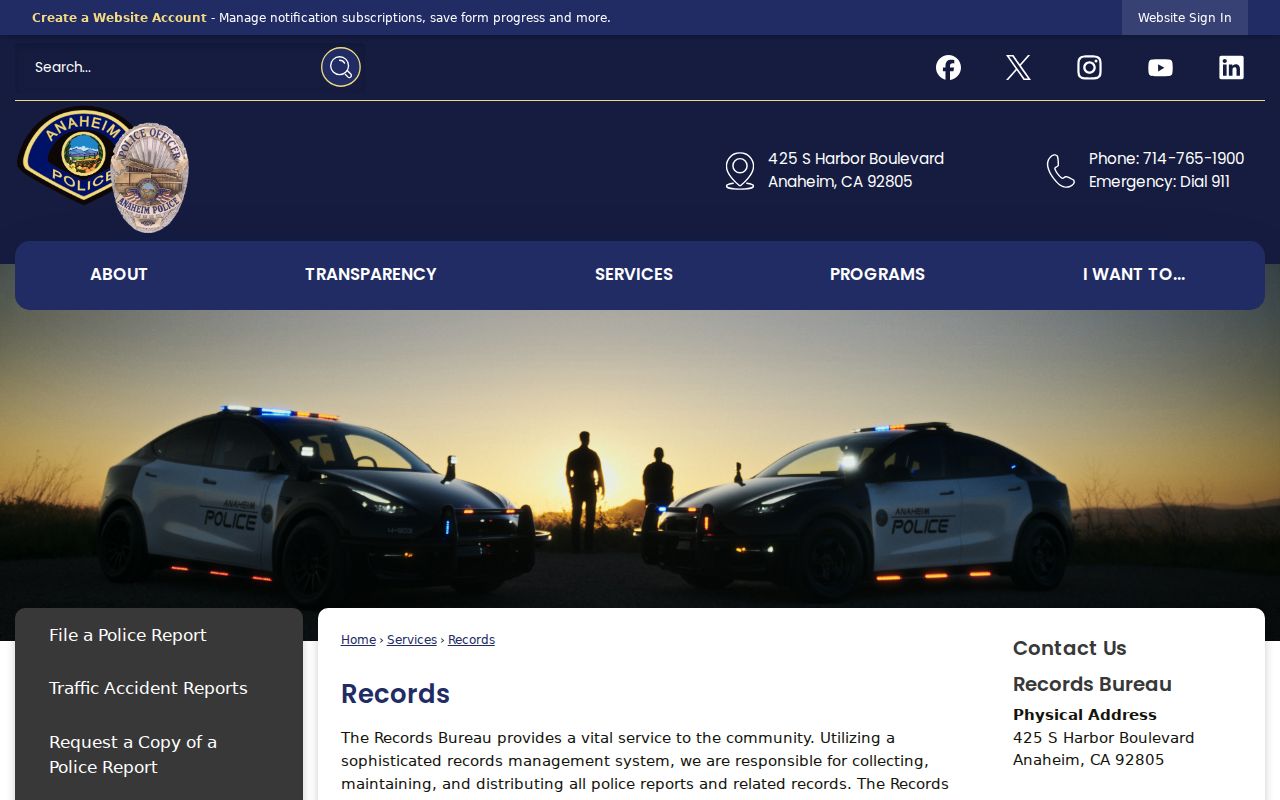
The page confirms that Anaheim police records stay with the department rather than a general county records counter.
The Anaheim Police Department
Anaheim Police Department holds the first official layer of many Anaheim criminal records: the incident report, arrest narrative, supplemental reports, and related local materials. The records office does not decide what criminal charge is ultimately filed. That decision belongs to prosecutors, and the filed complaint and later result appear in Orange County Superior Court.
The department's main number is (714) 765-1900, while records questions go to (714) 765-1990. Calling the records line first can clarify the proper request and whether identification or another release condition applies. The My Anaheim app is a city service, 311, event, and FAQ tool. Its official listing does not identify a criminal-history lookup or police-report copy function.
Anaheim Public Records Beyond Police Files
Anaheim provides a separate City Clerk route for public city records that are not obtained from the Police Records Bureau. A request may be made online or sent to the Custodian of Records, Office of the City Clerk, at 200 S. Anaheim Boulevard. The city also accepts requests at recordsrequest@anaheim.net, by fax at (714) 765-4105, by mail, or in person.
This distinction matters. A general city document belongs with the clerk, while an Anaheim police report begins with the department that created it. Duplication charges may apply. The city says copies are not made until payment is received, and an unpaid invoice may require a new request after 20 days.
The city's public records request instructions display those choices and payment terms.
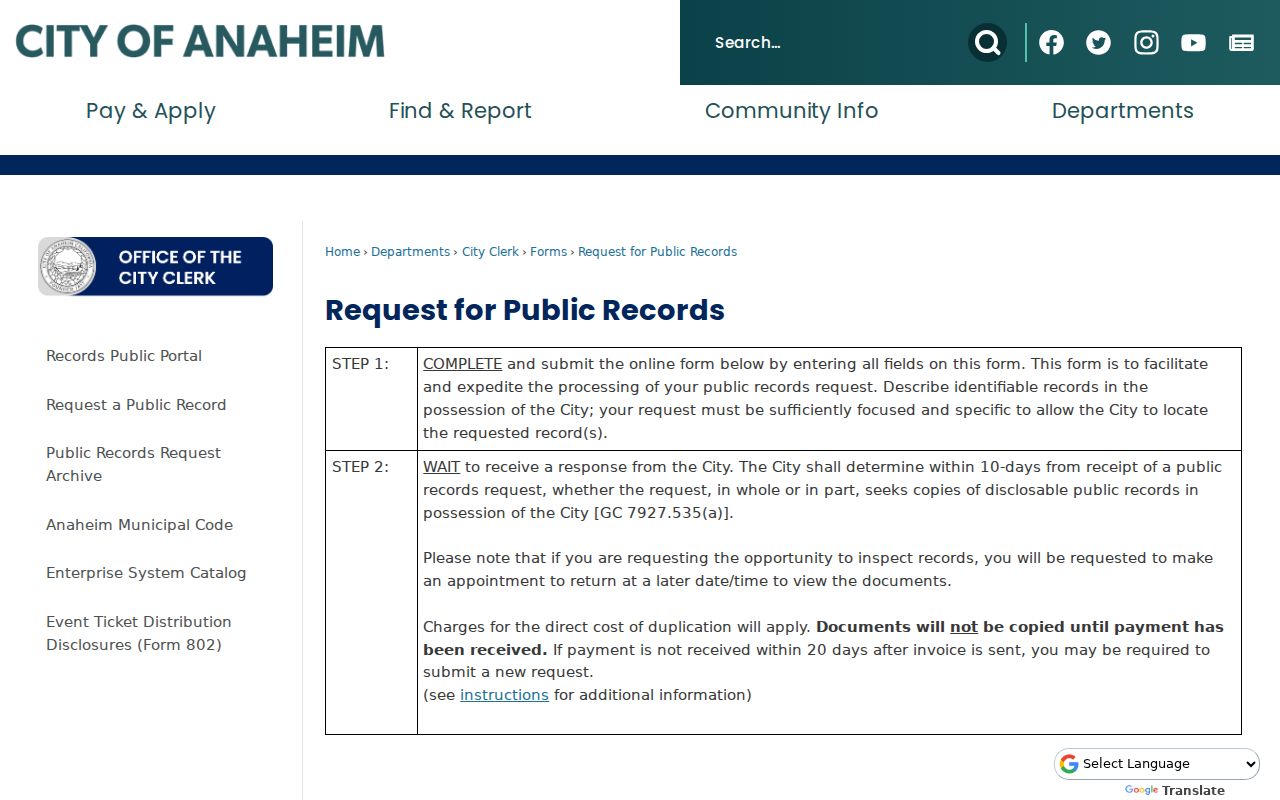
The official screen helps separate City Clerk records from the police report route used for Anaheim criminal history.
Arrests and Bookings in Anaheim
An Anaheim arrest begins as a city police record, but county custody creates a second record when the person is booked into the Orange County jail system. The Anaheim report can describe the officer's action and event. OCSD controls current county custody and booking information. Neither source alone proves that a prosecutor filed the same charge or that a court entered a conviction.
The OCSD Public Services Portal may require an account with an email address and password. Current county guidance also says its inmate system does not display charges. When that gap matters, use the Anaheim report for the arrest account and the Superior Court search for charges actually filed. The broader Orange County arrest history resource explains the county jail route in depth.
When Anaheim Police and Jail Records Split
A missing booking result does not establish that no Anaheim arrest occurred, and a booking entry does not show the final court outcome. Records appear on different schedules. Anaheim officers create a report first, OCSD creates custody data if a county booking follows, prosecutors review the report, and the Superior Court creates a case only when charges are filed.
Compare the event date, arresting agency, report number, booking number, and court case number when available. If the jail interface omits charge information, do not guess from the arrest narrative. The filed complaint, register of actions, minute orders, and disposition in the court file are the better source for what happened after arrest.
Anaheim Municipal Court Records
Anaheim does not operate a separate municipal criminal court for the case path documented here. California trial matters from Anaheim are handled through the Superior Court of California, County of Orange. Depending on geography and assignment, Anaheim matters may be associated with the North or Central Justice Center. The county portal is a starting point, while certified copies and older indexes come from the clerk.
| Court Name | Superior Court of California, County of Orange |
|---|---|
| Case Types Heard | Felony, misdemeanor, criminal, traffic, and related warrant matters |
| Case Lookup Channel | Vision Public, separate name search, calendar search, or the proper Justice Center clerk |
| What the Docket Shows | Public case events, hearings, charges, minute orders, warrants, disposition, and sentencing entries |
| Copies & Fees | Criminal clerk requests in person or by mail under the court's copy instructions |
Anaheim Report Copies and Court Copies
A police report and a court copy document different stages. Anaheim Police maintains the original agency report and supplements. Orange County Superior Court maintains the complaint or information, hearing record, pleas, orders, disposition, and sentence after a case is filed. One cannot reliably substitute for the other.
Vision Public warns that online information is not the official record. Search by case number when known, or use the separate name search. Prior-year indexes may be available only at the Justice Center where the case was filed. A formal copy request can identify the defendant, case number, date of birth if known, desired documents, and a phone number. The Orange County criminal court case records page explains that process fully.
Where Anaheim Records End Up
An Anaheim criminal record can move through several official systems. Anaheim officers create the local report. A county booking adds custody data. The Orange County District Attorney decides whether to file charges, and Superior Court records the court events and outcome. Fingerprints and reported dispositions can then become part of California's state criminal-history system.
Record flow: Anaheim Police Department › Orange County Superior Court › California Department of Justice
Recent activity is most likely to begin with Anaheim Police or county custody. A completed case belongs with the court, while a person reviewing their own statewide summary must use the California DOJ fingerprint process. California has no general-public name portal for another person's statewide rap sheet.
My Anaheim Is Not a Record Search
The official My Anaheim app can help residents reach city services, 311 information, events, and frequently asked questions. The inspected store description does not promise access to police reports, bookings, warrants, or criminal-history results. That limit prevents a useful city app from being mistaken for an Anaheim criminal record portal.
The My Anaheim App Store listing shows its service-oriented role.
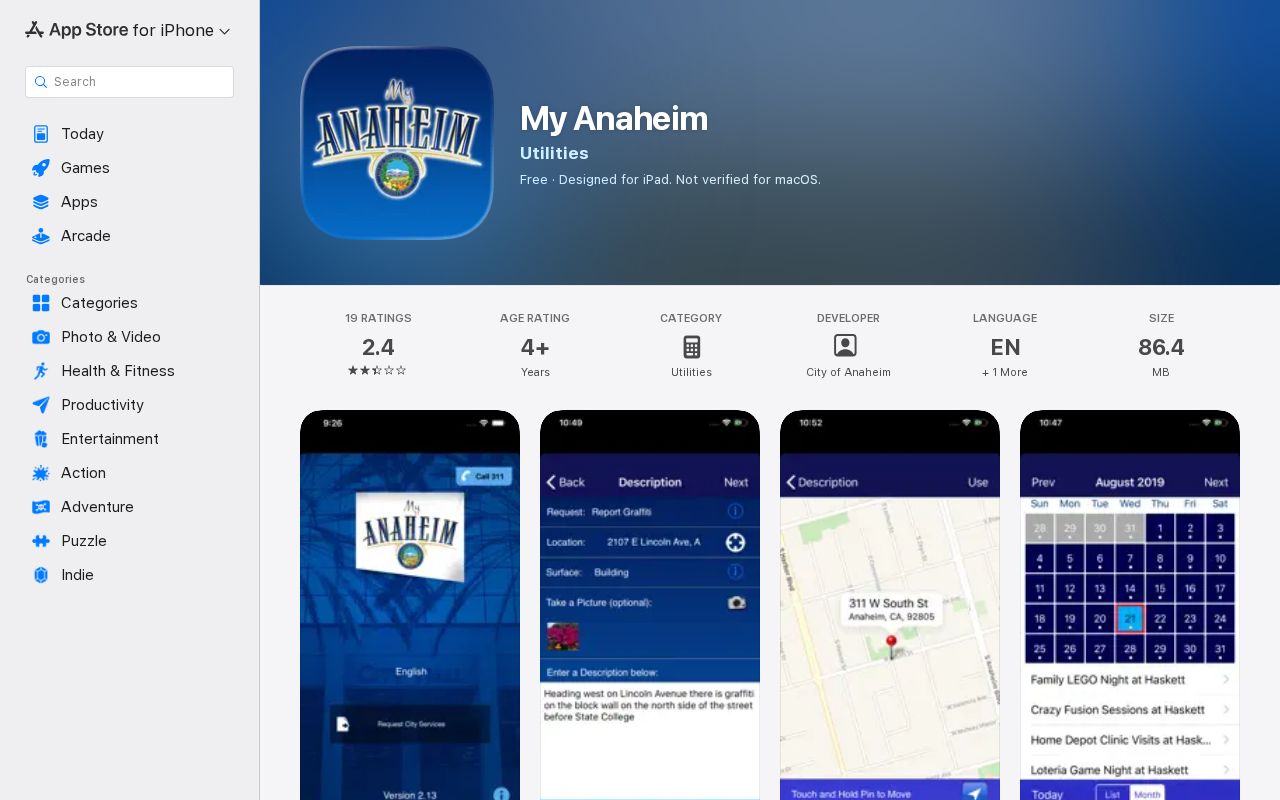
For criminal records, keep using Anaheim Police, Orange County custody and court systems, or California DOJ according to the record sought.
Anaheim Local Record Verification
If an Anaheim report is missing or appears wrong, begin with the bureau that created it. Give Anaheim Police Records the report number and exact event details. If the dispute concerns a charge, plea, dismissal, or sentence, verify it with the Superior Court rather than asking police staff to change a court entry.
A statewide discrepancy requires a different path. California DOJ's record review is fingerprint based and subject-only. It lets a person inspect, challenge, or correct their own state summary. The DOJ processing fee is $25 before the Live Scan provider's rolling fee, and a fee-waiver process exists. This route is not an Anaheim public name search.
Matching an Anaheim Record to Its Source
An Anaheim criminal history search is most reliable when the requester follows the identifiers created at each stage. The police report number belongs to Anaheim Police. A booking number belongs to the county custody system. A Superior Court case number belongs to the filed case. Those numbers can refer to the same event without being interchangeable. Write down the date, location, agency, and number shown on each response. If two records describe different arrest dates or agencies, do not merge them merely because the names match.
The Anaheim report is the best place to understand what officers recorded at the scene and why an arrest or citation occurred. It may contain narrative material that never appears in a public docket. Yet the arrest allegations are not the final set of charges. The Orange County District Attorney may file different counts, decline a count, or decline a case. A later plea, trial result, dismissal, and sentence appear in court records. This is why an Anaheim report copy and an Orange County court copy answer distinct questions.
Time also affects where a record can be found. A fresh Anaheim event may exist in the Records Bureau before a case appears in the Superior Court search. A county booking can appear while prosecutorial review is still underway. Older court matters may fall outside the online prior-year index and require contact with the Justice Center where the case was filed. Vision Public itself warns that its online data is not the official record. For a certified or complete copy, use the clerk rather than treating a search screen as final proof.
When a name search produces several candidates, compare the court location, case category, hearing date, and known case number. The public interface does not promise broad display of a full date of birth, and sensitive identifiers may be redacted. A common name therefore calls for more care, not broader assumptions. Anaheim Police Records can help locate its own report, but it cannot certify that a court result belongs to the same person. The Superior Court clerk is the source for its case file.
A requester reviewing their own statewide California history should not ask Anaheim Police or the City Clerk for a statewide rap sheet. California DOJ uses fingerprints because a fingerprint match is more reliable than a public name match. California residents use an approved Live Scan location and the appropriate record-review form. The $25 DOJ processing fee is separate from the provider's rolling fee. An out-of-state resident follows the fingerprint-card process described by DOJ. The result is for subject review, correction, or challenge, not a public search of another person.
When a record appears incomplete, first identify which office owns the missing fact. Anaheim Police can address its report. OCSD can address county custody material. Superior Court can address a filed charge, minute order, disposition, or sentence. California DOJ provides a discrepancy process for the person's state summary. Sending the same broad request to every office can create several partial answers. A narrow request that names the document and identifier is easier for staff to process and easier for the requester to compare.
Public access does not mean that every field will be released. A police file can contain victim information, confidential identifiers, juvenile material, or active-investigation details that must be withheld or redacted. A sealed court matter may not appear in the ordinary public view. An arrest that qualifies for relief may have limited visibility. These restrictions can explain an absent field without proving the underlying event never occurred. Ask the holding office whether the response is a no-record result, a redacted release, or a record that cannot be disclosed.
The City Clerk request process is useful for Anaheim government records outside the specialized police channel. Its mail, fax, email, in-person, and online choices give a requester several ways to submit a focused description. The payment rule matters when duplication is required: copies are held until payment, and waiting more than 20 days after an invoice may mean starting again. Keep the invoice and request confirmation with the response so the history of the public-record request remains clear.
Anaheim's size does not change this division of responsibility. City police document Anaheim incidents, while OCSD runs the county jail and Superior Court runs the county criminal docket. The fact that an arrest began in Anaheim does not create an Anaheim municipal criminal case database. Likewise, the My Anaheim app can support general city-service navigation without becoming a police record system. Using the named official source for each stage is slower than relying on one result, but it produces a more accurate picture.
Public Access Rules
The California Public Records Act supports requests for non-exempt records held by Anaheim, but it does not turn every police file or statewide criminal-history entry into an open record. Active-investigation material, juvenile information, victim details, sealed records, and confidential identifiers may be withheld or redacted. Court access follows judicial rules, and California DOJ dissemination is separately restricted.
Key Statutes:
California Public Records Act - establishes the general public-records framework used for Anaheim requests.
Penal Code § 11105 - limits dissemination of state summary criminal-history information.
Penal Code § 11124 - supports access to a person's own California summary through DOJ review.