
Criminal Cases in the Orange County Courts
The Orange County Superior Court Criminal Division handles both felony and misdemeanor matters. Its file begins when a citation, complaint, information, or grand jury indictment reaches the court. From that point, the clerk keeps the case number, party entries, hearing calendar, register of actions, minute orders, plea, disposition, and sentence. Those are court facts. An OCSD booking entry may show custody, but it cannot substitute for the filed case.
Criminal operations are spread across Central, North, West, and Harbor justice centers. Central Justice Center in Santa Ana has felony and misdemeanor departments and receives matters from throughout Orange County for specified felony and mental-health proceedings. North serves much of northern Orange County, West covers western communities, and Harbor serves coastal and south-county matters. The filing location matters because older indexes and paper copies remain with the relevant justice center.
Orange County Vision Public Limits
The Superior Court describes its Criminal Division and public services on the page shown below. It distinguishes the court's filed case from records created by law enforcement before filing.
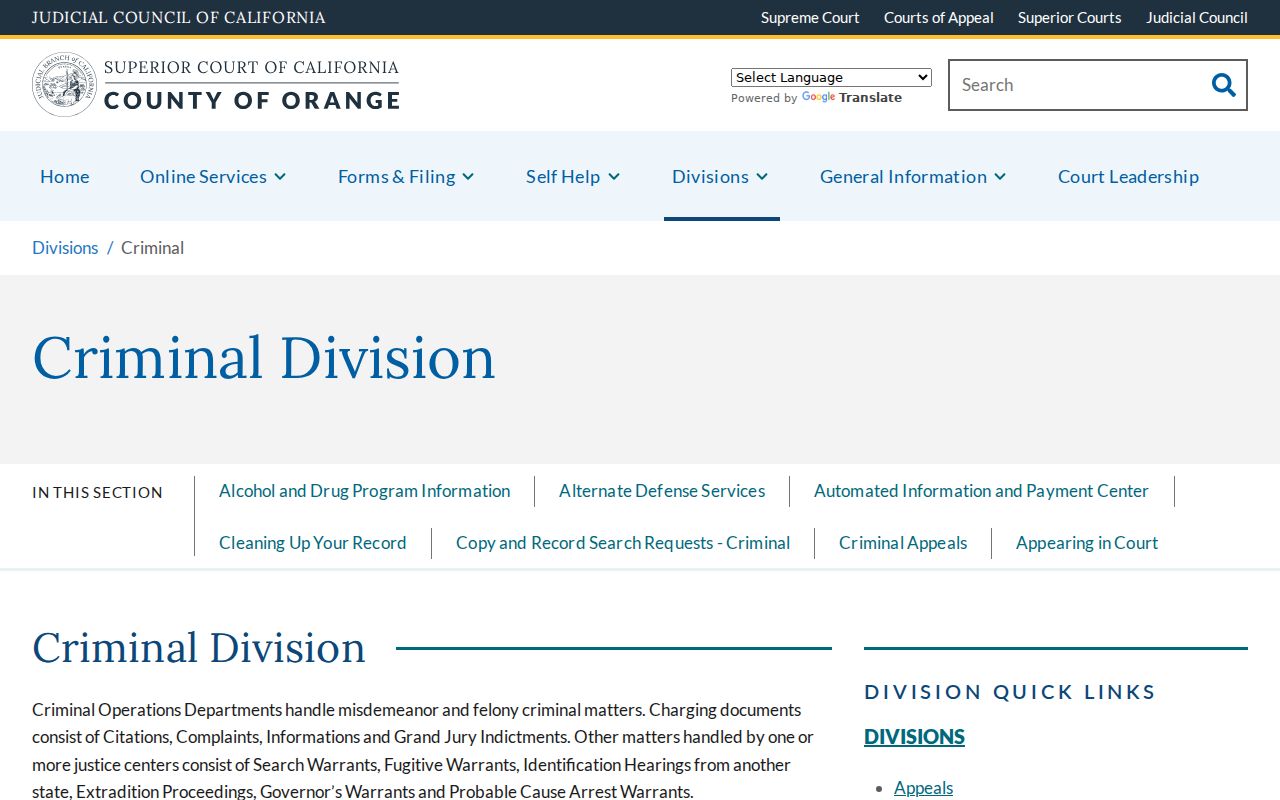
The division page is the right place to confirm which court service owns the next step, especially when a search result and a booking record do not match.
Vision Public is free and supports case-number and calendar paths, with a separate name-search service. The court warns that its online data is not the official record. A common name may produce a false match, and a docket may change after the last online update. Treat the portal as an index. Use a clerk-issued copy or certified copy when the exact wording of an order, plea, or judgment is the point of the search.
How to Search Case Records
A case number is the strongest key. If it is unknown, the separate person or business name search can locate possible files. Calendar search is useful for a known hearing and can be narrowed by justice center, courtroom, prosecutor, and hearing date.
- Open Vision Public and read the official-record warning.
- Enter the case number when known, or use the separate name search.
- For a hearing, choose the justice center, courtroom, prosecutor, and date.
- Read the register of actions, charge entries, hearings, and disposition together.
- Ask the filing justice center for an official or certified copy when needed.
| Field label | Type | Required | Orange County use |
|---|---|---|---|
| Case number | Text | No | Best direct key for Vision Public |
| Person or business name | Separate search | No | Finds possible cases when the number is unknown |
| Justice Center | Select | No | Calendar defaults to all locations |
| Courtroom or prosecutor | Select/text | No | Narrows a calendar search |
| Hearing date | Date | For calendar | Confirms a scheduled appearance |
Orange County Copy Requests
The criminal copy and record-search page explains the in-person and mail routes. Its screenshot below is useful when the online docket identifies a case but does not supply the needed document.
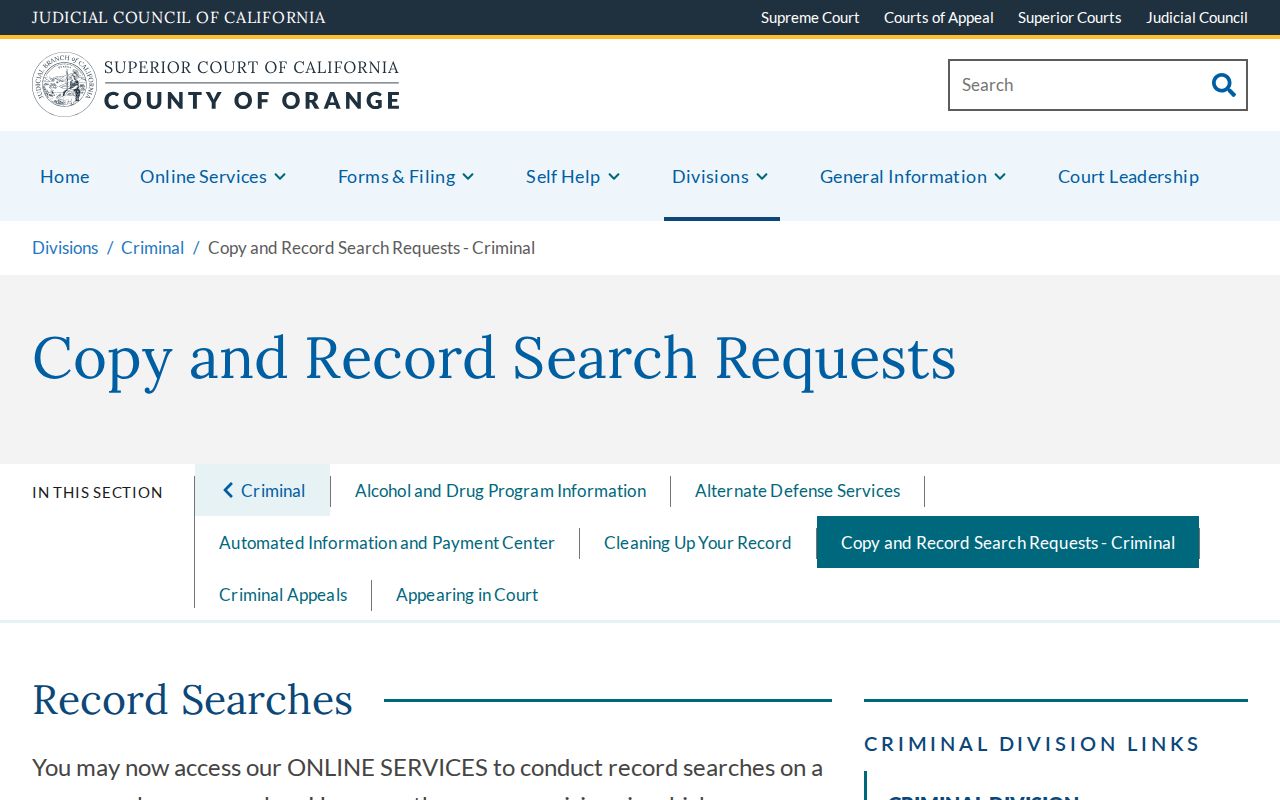
The court directs requesters to form L-3009 and asks for details that let staff distinguish the right file.
Include the defendant's name, case number, date of birth and driver's-license number if known, the exact documents sought, and a phone number. Mail payments go to the Clerk of the Court, and cash should not be mailed. When the cost is unknown, the court permits a check marked not to exceed $25.00. A broad request for “the whole file” can be slower and less useful than asking for a complaint, minute order, disposition, or judgment by name.
What the Case File Shows
The case file records what prosecutors filed and what the judge did. It does not simply repeat the arrest report. Charge wording can change after arrest, and each count can have its own result.
| Case Number & Court | Unique court identifier and filing justice center. |
|---|---|
| Charging Document | Citation, complaint, information, or indictment stating filed counts. |
| Docket Entries | Chronological register of filings, hearings, motions, and orders. |
| Hearing Dates | Past and scheduled appearances, courtroom, and calendar details. |
| Disposition & Judgment | Outcome for each charge, such as dismissal, plea, acquittal, or conviction. |
| Sentence & Conditions | Custody, probation, fines, and other terms ordered by the court. |
Note: A docket summary can point to an order, but the clerk's copy supplies the order's controlling text.
Older Orange County Criminal Indexes
The Superior Court records overview says court records date to 1898 and explains the split between online and older access. The captured page below marks the official starting point for historical case work.
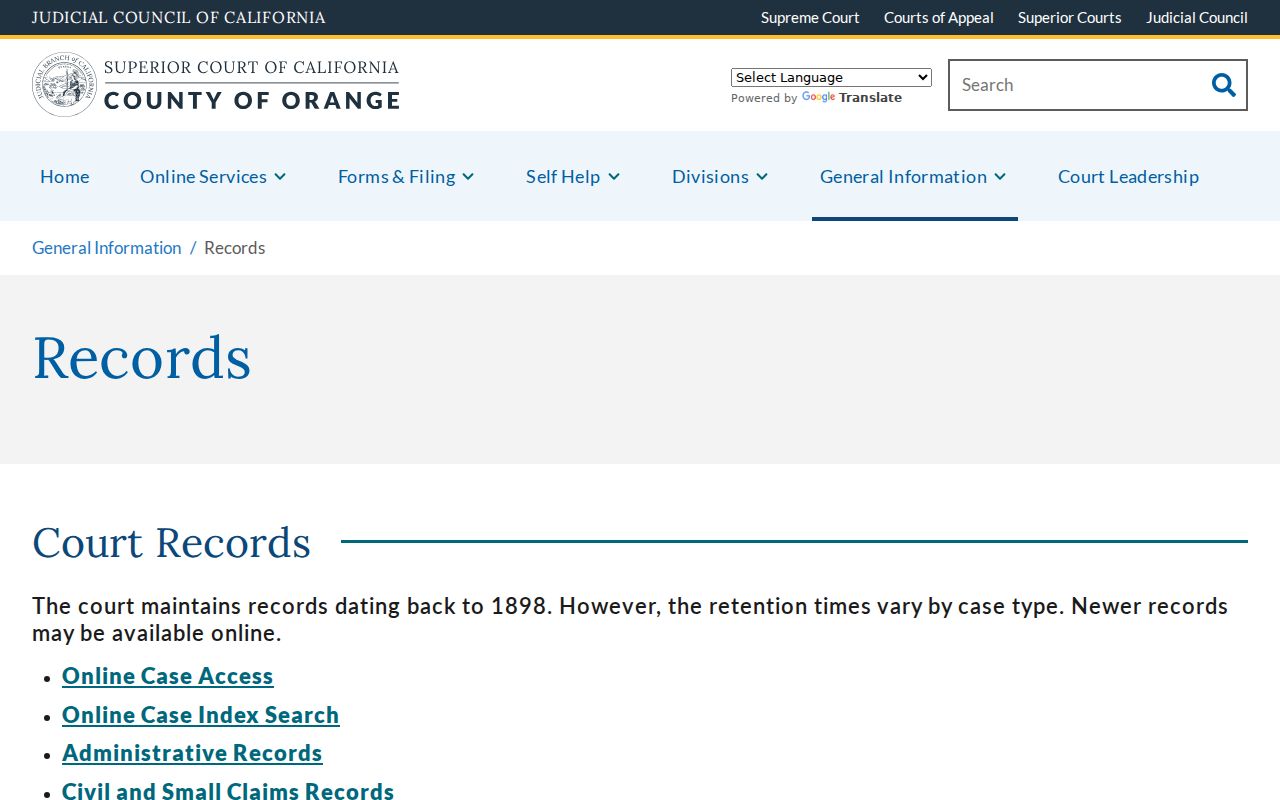
That long record span can aid genealogy and local-history research, but it does not mean every old file is indexed online.
Prior-year indexes are kept at the respective justice center. If a name search returns nothing, first check the likely filing year and geography rather than assuming no case exists. Bring or send as many identifiers as the research permits. The clerk may need to distinguish names across older ledgers or indexes. A record may also be absent because it is sealed, juvenile, destroyed under a lawful retention rule, or otherwise restricted.
Stages of a Criminal Case
The prosecutor's filed charge begins the court record. Arraignment is the first formal court appearance at which charges and plea rights are addressed. Pretrial entries may include motions, discovery issues, scheduling, and plea talks. A plea or trial then leads to a result on each count. If there is a conviction, the court records judgment and sentence. Later probation, warrant, or record-cleaning orders can add new entries.
Case flow: Charges Filed › Arraignment › Pretrial › Plea or Trial › Disposition › Sentencing
That flow explains why a fresh arrest may not yet appear in Vision Public. Police and jail records can exist before the District Attorney files a complaint. For the earlier custody trail, use the county's Orange County arrest history channels.
Orange County Justice Center Records
The North Justice Center location page identifies the Fullerton court serving northern Orange County. The image below helps distinguish a physical clerk location from the countywide online portal.
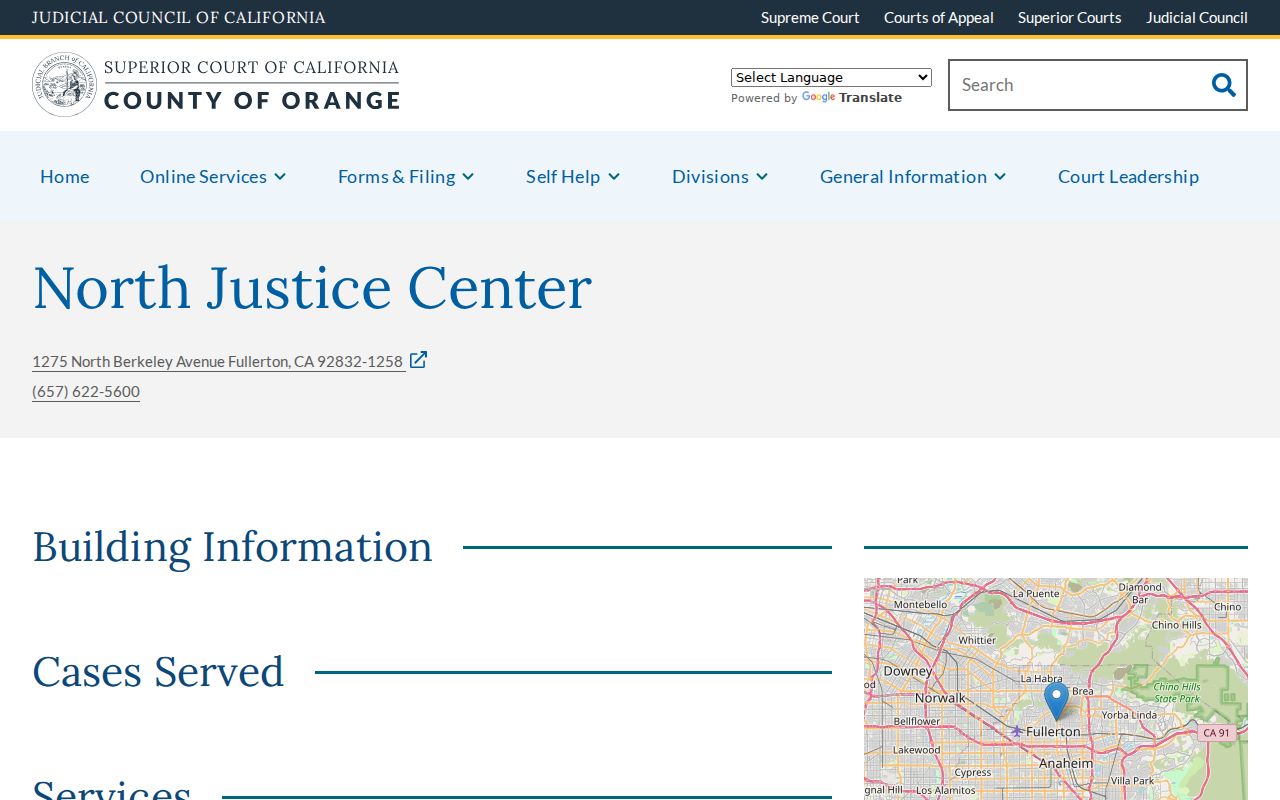
A case filed there remains a Superior Court case, yet its older index and copy counter may be tied to North Justice Center.
The West Justice Center page provides the Westminster location for west-county criminal and traffic business. Its source image follows.
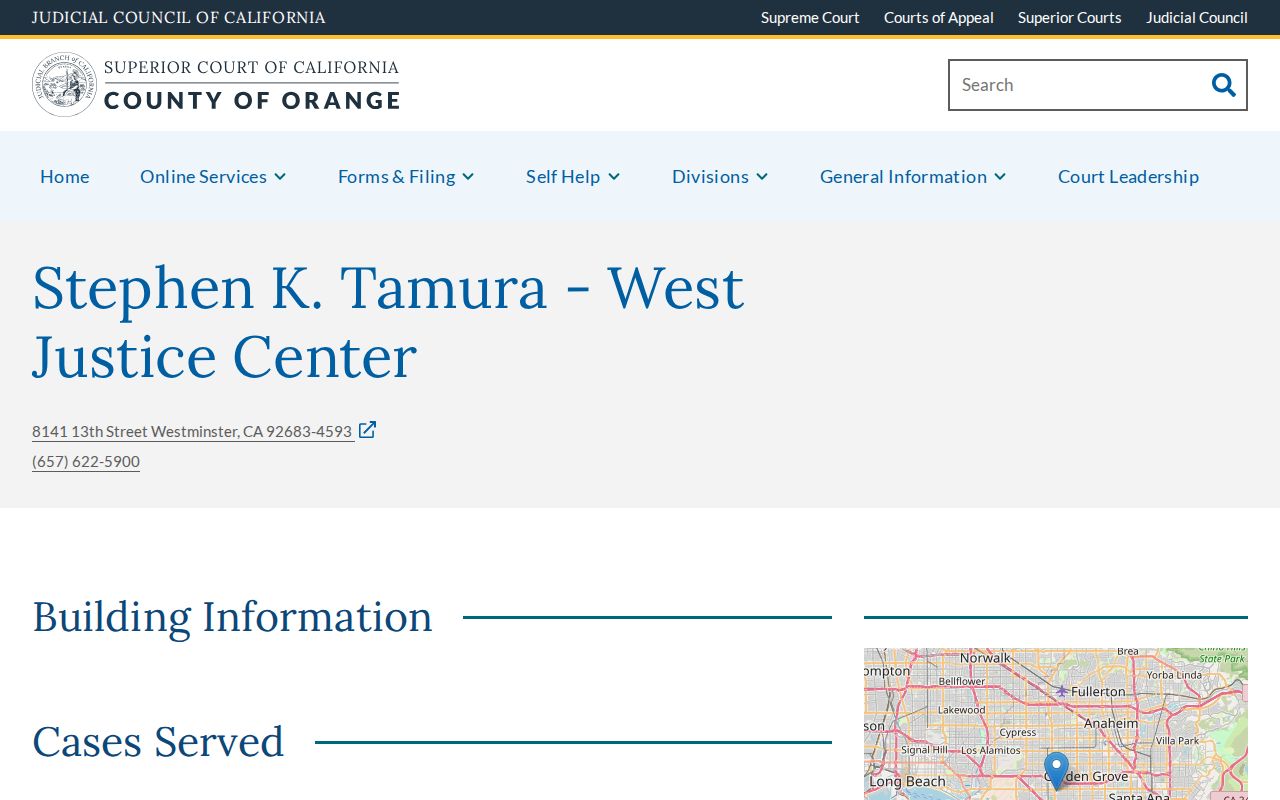
Before a visit, confirm the filing site, current counter hours, and any security rules on the official location page.
Central Justice Center is at 700 Civic Center Drive West in Santa Ana. Its main number is (657) 622-6878, and the felony and misdemeanor line is (657) 622-8459. North is at 1275 N. Berkeley Avenue in Fullerton, West at 8141 13th Street in Westminster, and Harbor at 4601 Jamboree Boulevard in Newport Beach. These locations form one county Superior Court system, not separate municipal criminal courts.
Reading Orange County Charge Results
A complaint commonly starts a prosecution. An information is a felony charging document used after the preliminary-hearing stage or waiver, while an indictment comes from a grand jury. The register of actions is the time-ordered event list. A minute order is the court's official summary of a hearing or ruling. “Disposition” means the result of a charge, not merely that the file is closed.
- Dismissal
- A charge ends without a conviction on that count.
- Acquittal
- A not-guilty result after trial.
- Conviction
- A guilty verdict or qualifying guilty or no-contest plea.
- Wobbler
- A California offense that may be treated as a felony or misdemeanor.
Read results count by count. One Orange County case can contain a dismissed count and a conviction on another. Penal Code section 17 governs felony, misdemeanor, and wobbler treatment, so the final minute order and judgment are more reliable than an arrest label.
Access & Restrictions
Public access is broad for many adult criminal court records, but not absolute. Juvenile files, sealed matters, victim information, sensitive identifiers, and records covered by a court order may be hidden or redacted. Online views can be narrower than the official file. The California Public Records Act governs many agency records, while court access and clerk rules control the judicial file. A CPRA demand to the Sheriff is not a substitute for a request to the court clerk.
If a known Orange County case does not appear, ask the filing justice center about the year, index, and access status. Do not infer that the arrest never occurred or that the case was cleared. A sealed or restricted result may be lawfully absent, while an older case may simply sit outside the online index.