
How to Check Criminal History in Orange County
A sound Orange County search starts with the kind of fact being checked. Filed charges and dispositions belong to the Superior Court. Current custody and recent booking data belong to the Orange County Sheriff's Department. The underlying incident report stays with OCSD or the city police department that made the arrest. A California Department of Justice summary is different again: it is a fingerprint-based review that a person requests for their own record.
Gather a full legal name, spelling variants, date of birth if lawfully available, a case or report number, and the likely date and city. Those details help separate people with common names. Then follow the record from its source instead of treating one result as the whole history.
- Search the Orange County Superior Court by case number or use its separate person and business name search.
- Check the OCSD Public Services Portal when current custody or a recent booking is the question.
- Contact the arresting agency for an incident or arrest report, since city police reports do not move into a countywide report portal.
- Ask the court clerk for an older index, record search, or copy when online case data is incomplete.
- Use California DOJ Live Scan record review to inspect and challenge your own statewide summary.
Record flow: Police report › OCSD booking › District Attorney filing decision › Superior Court case › DOJ disposition update.
Orange County Vision Public Searches
The Vision Public criminal and traffic search is the main online entry for Orange County court records. It exposes a case-number path and a calendar path. A separate application handles person or business names. The court warns that portal data is not the official record and that name-to-case associations may be wrong. Treat a match as a lead, then compare the court location, dates, case type, and docket events.
The official Vision Public screen shows how the portal frames an Orange County criminal case search.
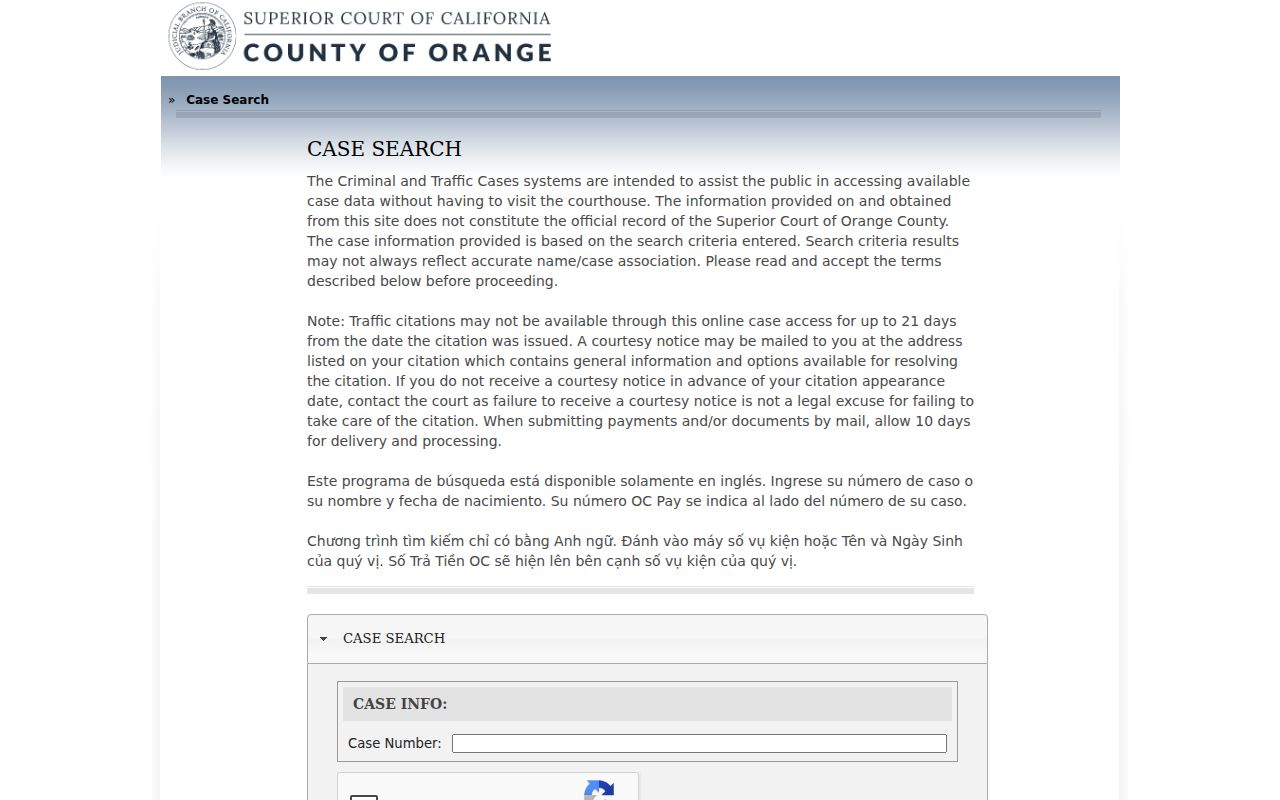
Its anti-automation check and split search routes explain why a case number is the cleanest starting key.
| Search field | Use | What to know |
|---|---|---|
| Case Number | Direct case search | Best match when the exact number is known. |
| reCAPTCHA | Required verification | Must be completed before submission. |
| Justice Center | Calendar filter | Defaults to all locations. |
| Courtroom or Prosecutor | Calendar filter | Useful with a hearing date. |
| Person or Business Name | Separate route | Use the linked name-search application. |
The court's case-access overview explains what is available online.
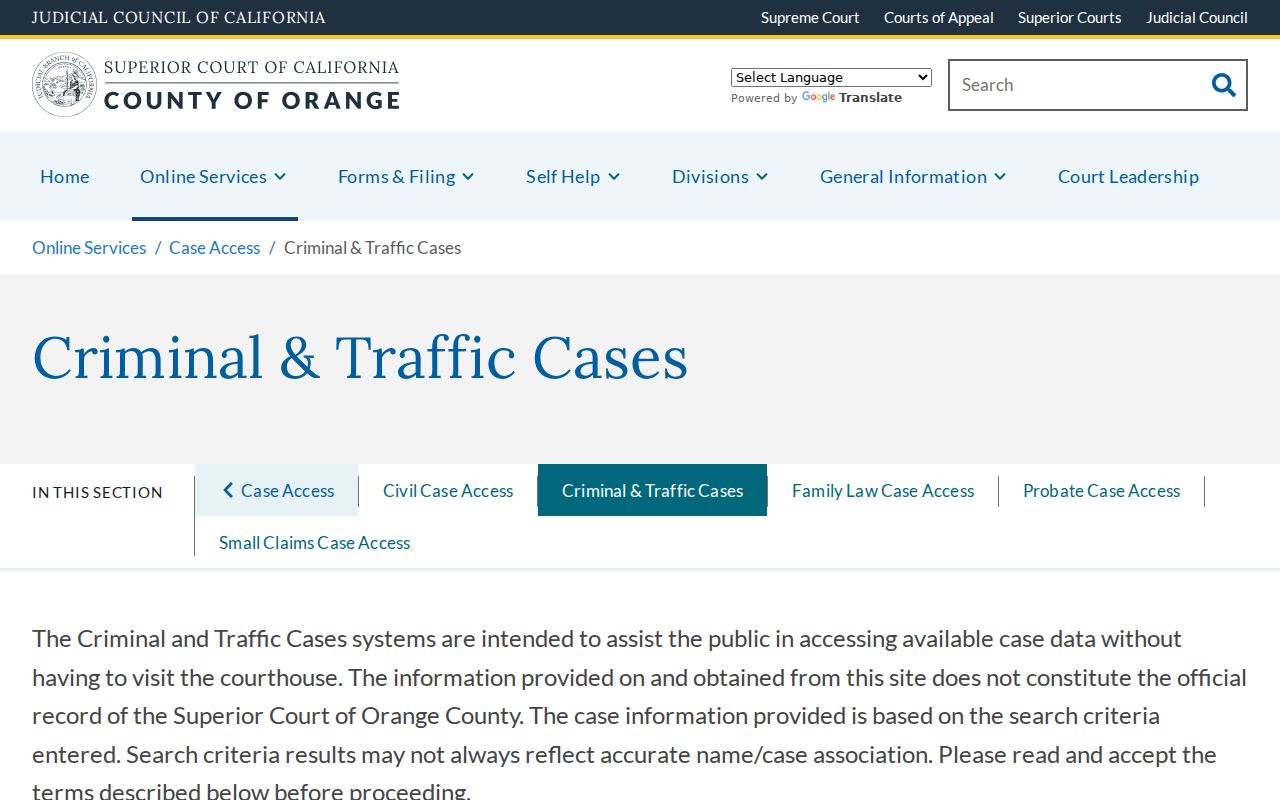
That page is the right checkpoint before requesting an official copy from criminal operations.
Official California Background Checks
California has no public portal that lets anyone run a statewide criminal-history search on another person by name. The official self-review channel is the California DOJ record-review process. California residents submit fingerprints through Live Scan, use the DOJ record-review form, show valid photo identification, and pay a $25 DOJ processing fee plus the provider's rolling fee. A fee waiver may apply to qualifying California residents.
The DOJ record-review page distinguishes a subject's state summary from a public Orange County court search.
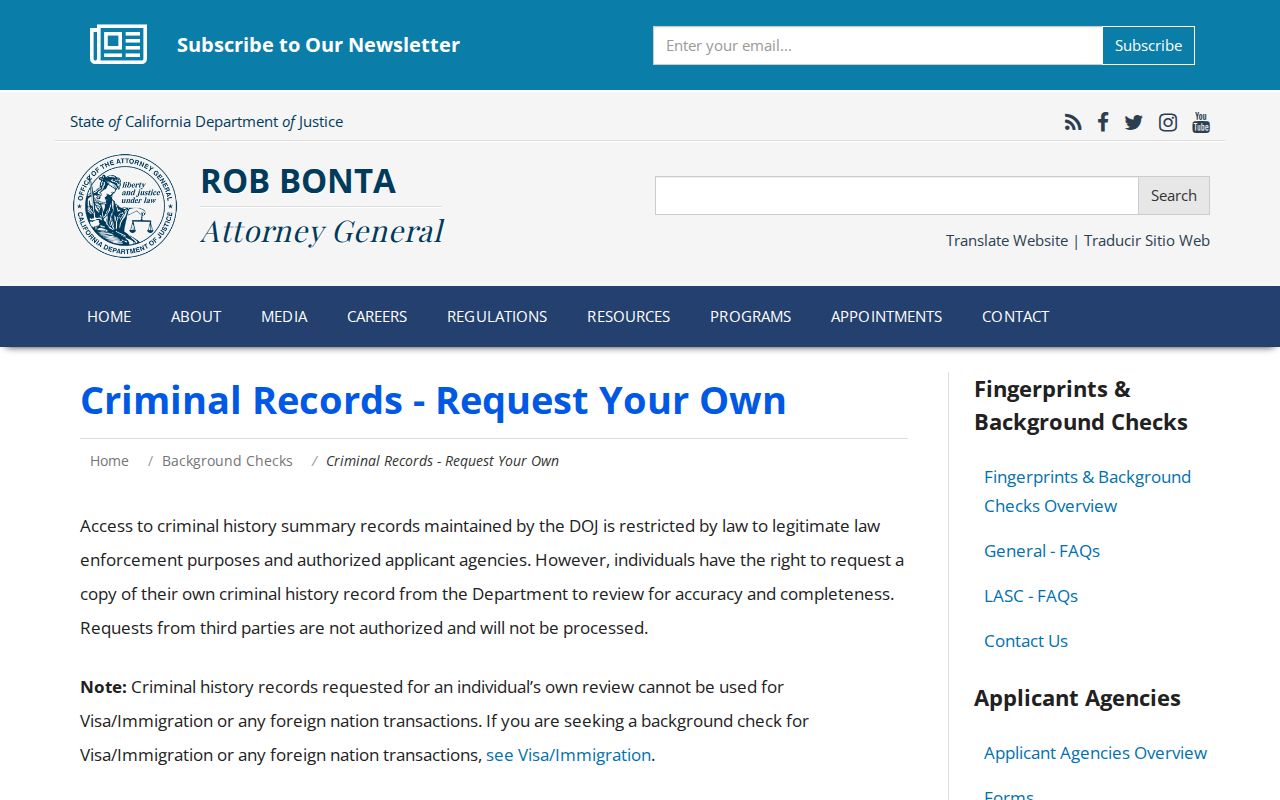
If a disposition is missing, DOJ directs the subject to the court that handled the case so corrected data can be sent to BCIA.
Four Orange County Record Custodians
No single Orange County office owns every stage. The agency that made the arrest keeps the report. OCSD creates the county jail record. The District Attorney makes a filing decision, and the Superior Court keeps the public case file. DOJ/BCIA receives fingerprint and disposition data for the state summary. Each source answers a different question.
| Source | Best for | Main limit |
|---|---|---|
| OCSD or city police | Incident and arrest reports | Release rules and exemptions apply. |
| OCSD jail system | Current custody and booking events | The current public system does not show charges. |
| Orange County Superior Court | Filed charges, hearings, disposition, sentence | Online data is not the official record. |
| California DOJ/BCIA | Your own statewide fingerprint summary | No public name search for other people. |
The official person and business name search supports the court layer.
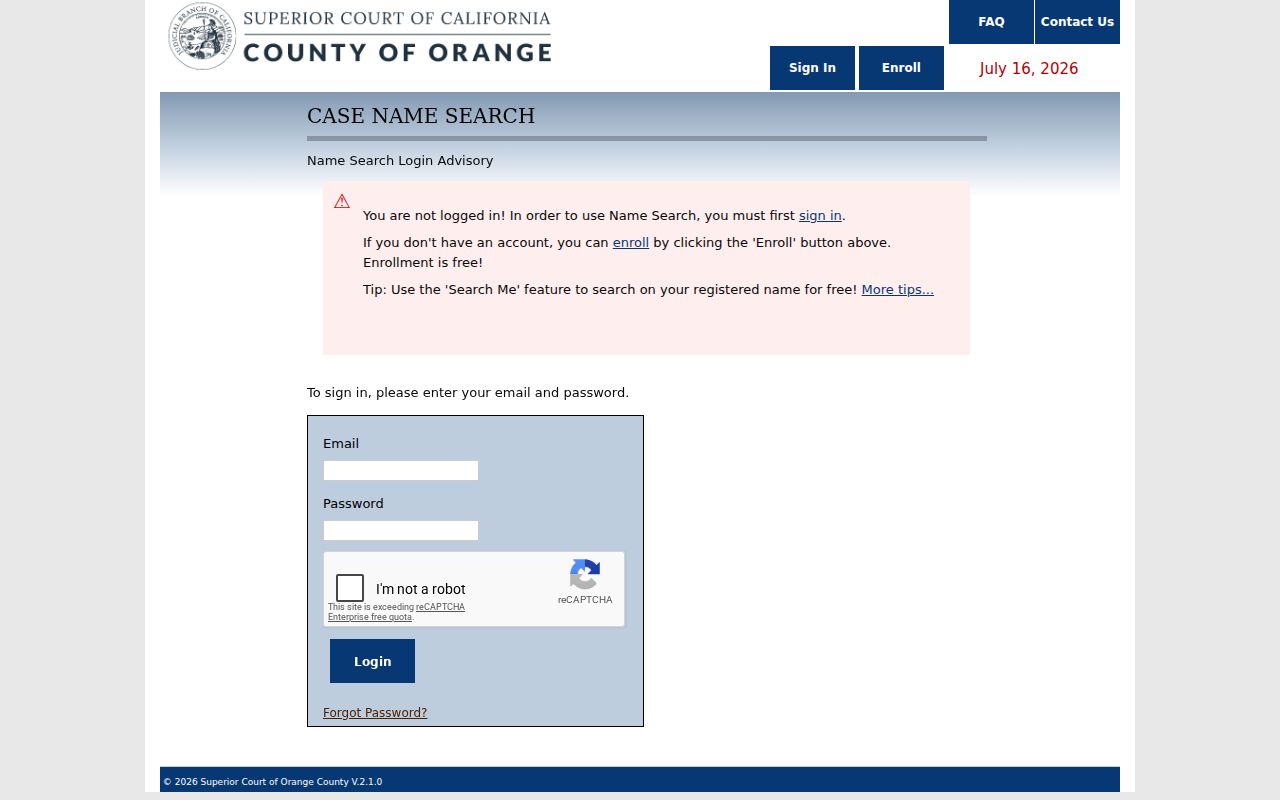
Common-name results still need verification against the clerk's record.
Types of Criminal Records
Orange County criminal records differ in purpose and timing. A booking can exist before prosecutors file a charge. A court file can show a lesser or different charge than the arrest report. A state summary depends on fingerprint and disposition reporting. Registry and supervision systems sit outside those three streams.
- Arrest and booking records: agency and jail records that document an arrest and custody event.
- Criminal case files: complaints, informations, minute orders, hearings, pleas, dispositions, warrants, and sentences.
- State summaries: fingerprint-linked arrest cycles and reported outcomes held by DOJ/BCIA.
- Warrant records: court-issued actions checked through the court and OCSD Central Warrant Repository.
- Custody and supervision records: county jail, Orange County Probation, CDCR prison, and parole information.
Orange County Booking Record Limits
The OCSD Public Services Portal carries the Inmate Information System and Booking Log. First-time users must create an account with an email address and password. The Sheriff's current notice says enhanced security now governs access. It also states that inmate charges are not displayed in the current public version.
The portal landing view signals that Orange County booking access now sits behind an authenticated service.
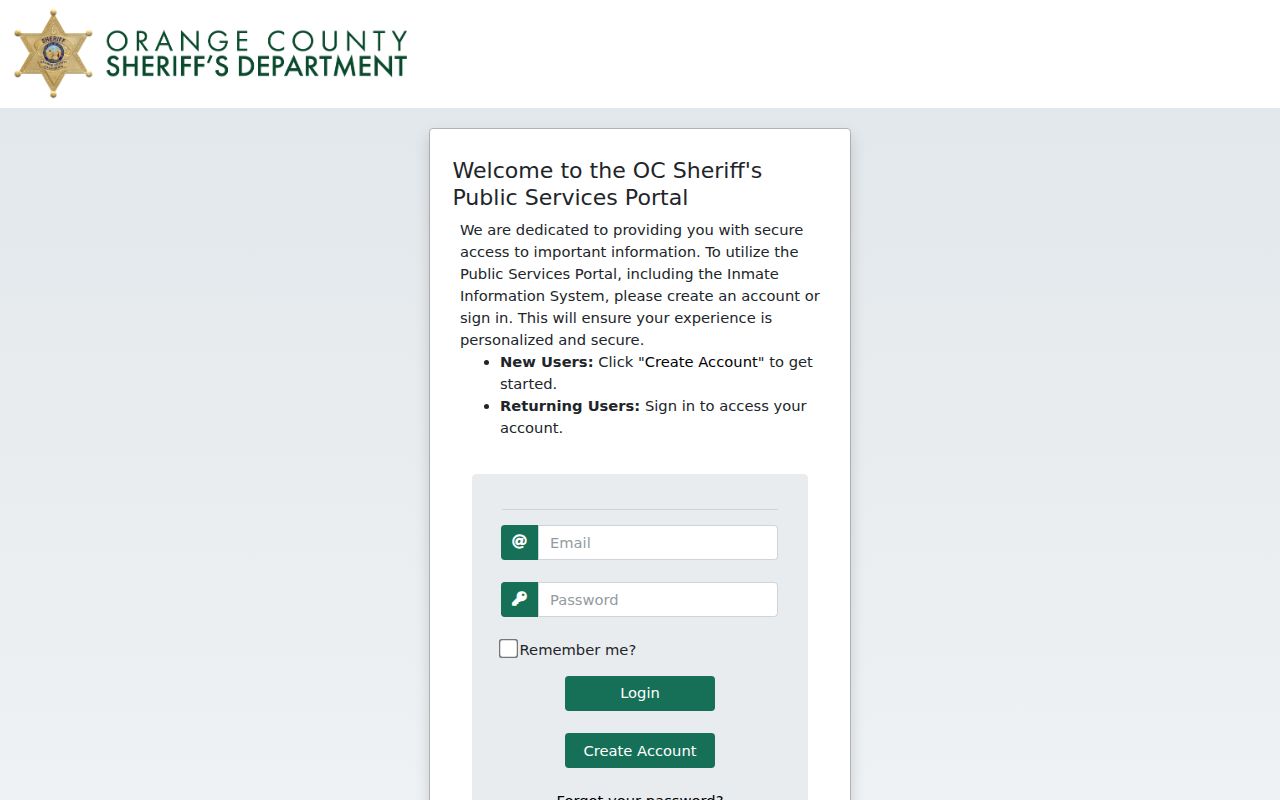
When a custody match lacks charges, move to the court name search or ask the arresting agency through an authorized channel.
The OCSD inmate information notice states the charge-display limit directly.
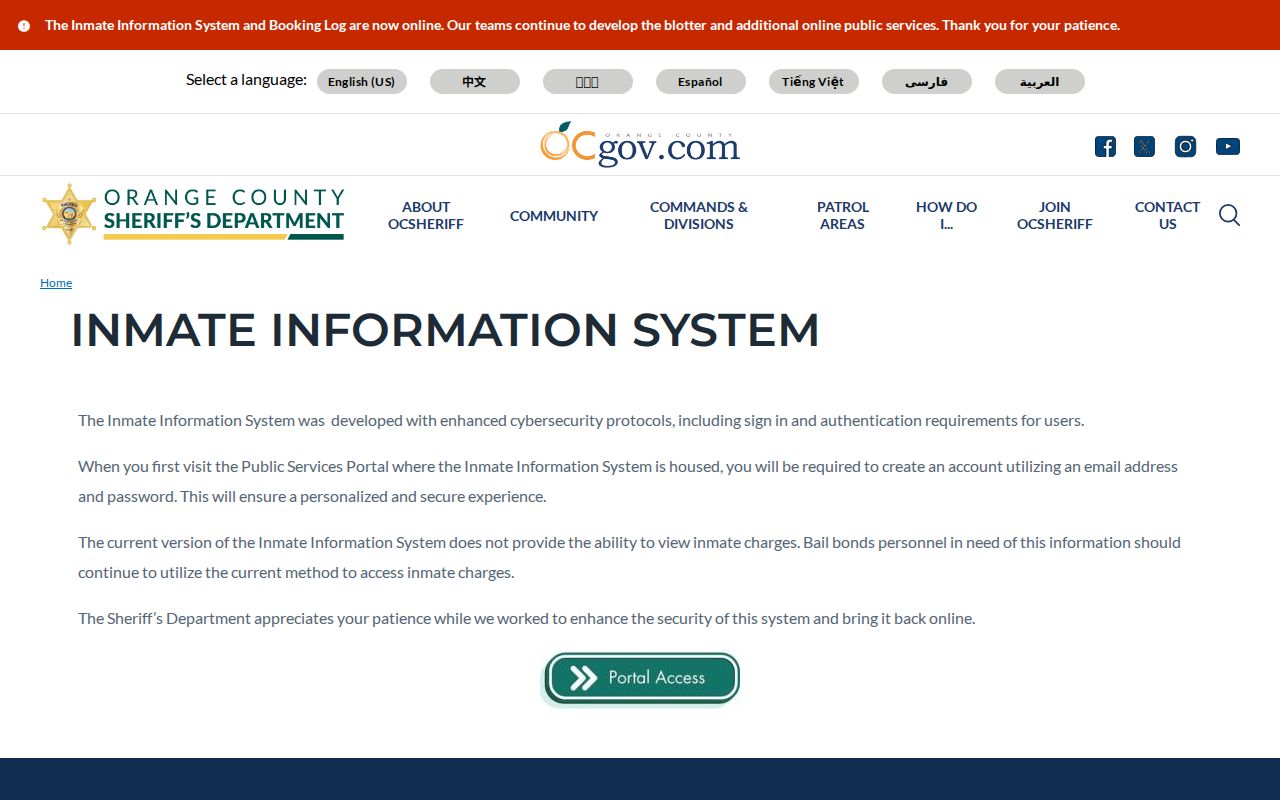
This gap is why a jail result and a court result should never be treated as interchangeable.
What an Orange County Criminal Record Shows
The fields depend on the custodian. A court record is case-focused, a booking record is custody-focused, and a DOJ summary is person-focused. The same event may carry a court case number, a police report number, a booking number, and a Live Scan ATI number. Those keys are not substitutes for one another.
| Name and Identifiers | Legal name, aliases, date of birth or age where lawfully shown, and source-specific identifiers. |
|---|---|
| Arrest and Booking | Agency, arrest date, report number, booking number, facility, custody, and release data. |
| Charges | Counts alleged at arrest or filed in court, which may differ as the case moves. |
| Disposition | Dismissal, acquittal, conviction, or another current or final outcome for each count. |
| Sentence | Custody, fines, probation, and court-ordered terms when part of the public file. |
| Supervision | Orange County probation or state custody and parole data when publicly available. |
- Register of actions
- The court's chronological list of case events.
- Minute order
- The official written summary of a hearing or order.
- Disposition
- The result or present status of a charge.
- Wobbler
- A California offense that may be treated as a felony or misdemeanor.
When Orange County Records Disagree
A jail entry may appear before a prosecutor files charges. A court case may list charges that differ from those first alleged. The portal may also omit an older index, while the DOJ summary may lag if a disposition was not reported. Start by noting which system produced each result and the date it was checked.
For a court conflict, request the register of actions or copies from the Justice Center. For a state-summary error, use the DOJ Claim of Alleged Inaccuracy or Incompleteness process and ask the Orange County Superior Court to send corrected case information when needed. For a police report issue, return to OCSD or the city records unit that wrote it.
Note: An online match is a lead, while the record custodian's certified or official copy is the sound source for confirmation.
Public Access Laws
The California Public Records Act supports requests to Orange County and city agencies, but it does not make every criminal-history file public. Court records follow court access rules. State summary data has tighter dissemination limits. Active investigations, juvenile files, victim and witness data, sealed records, and some registry information may be withheld or redacted.
Key California laws:
Government Code section 7920.000 begins the California Public Records Act.
Government Code section 7927.700 covers the determination period and extensions cited by OCSD.
Penal Code section 11105 limits dissemination of state summary criminal history.
Penal Code section 11124 supports a person's access to their own state summary.
Orange County Warrant Confirmation
Orange County does not publish an official countywide warrant list in the researched sources. The direct route is the OCSD Central Warrant Repository at (714) 834-6470, available around the clock. A court case search may show a bench-warrant event, but the online record is not final proof of current status. Confirm the matter with the criminal clerk at the Justice Center that issued it.
The Superior Court Criminal Division handles search warrants, fugitive warrants, extradition matters, governor's warrants, and probable-cause arrest warrants. Anyone resolving their own warrant should ask the clerk or counsel about the correct appearance, surrender, or calendar process, then confirm the recall with both the court and repository after action is taken.
Sealed, Expunged & Restricted
California Courts calls the process “clean your record.” True expungement does not erase every trace. Depending on the record, relief may include a Penal Code section 1203.4 dismissal, reduction of a wobbler, arrest sealing, factual-innocence relief, or automatic arrest relief. The case number, disposition, and proof that sentence or probation terms were completed are useful before filing.
Orange County petitions go to the Superior Court that handled the case. CR-180 is the Petition for Dismissal, and CR-181 is the proposed order. Juvenile records, active investigations, protected victim information, and non-public registry categories remain subject to separate limits. Law enforcement and authorized agencies may retain access even when a public portal no longer shows a record.
Orange County Custody Records
County jail custody and state prison custody use different systems. OCSD runs local booking and jail records. After a state-prison sentence, the official public locator is CDCR's California Incarcerated Records and Information Search. County probation is managed by Orange County Probation, while parole release decisions and field supervision sit with the Board of Parole Hearings and CDCR.
The CIRIS page is the state-level search layer for a person no longer found in the Orange County jail system.
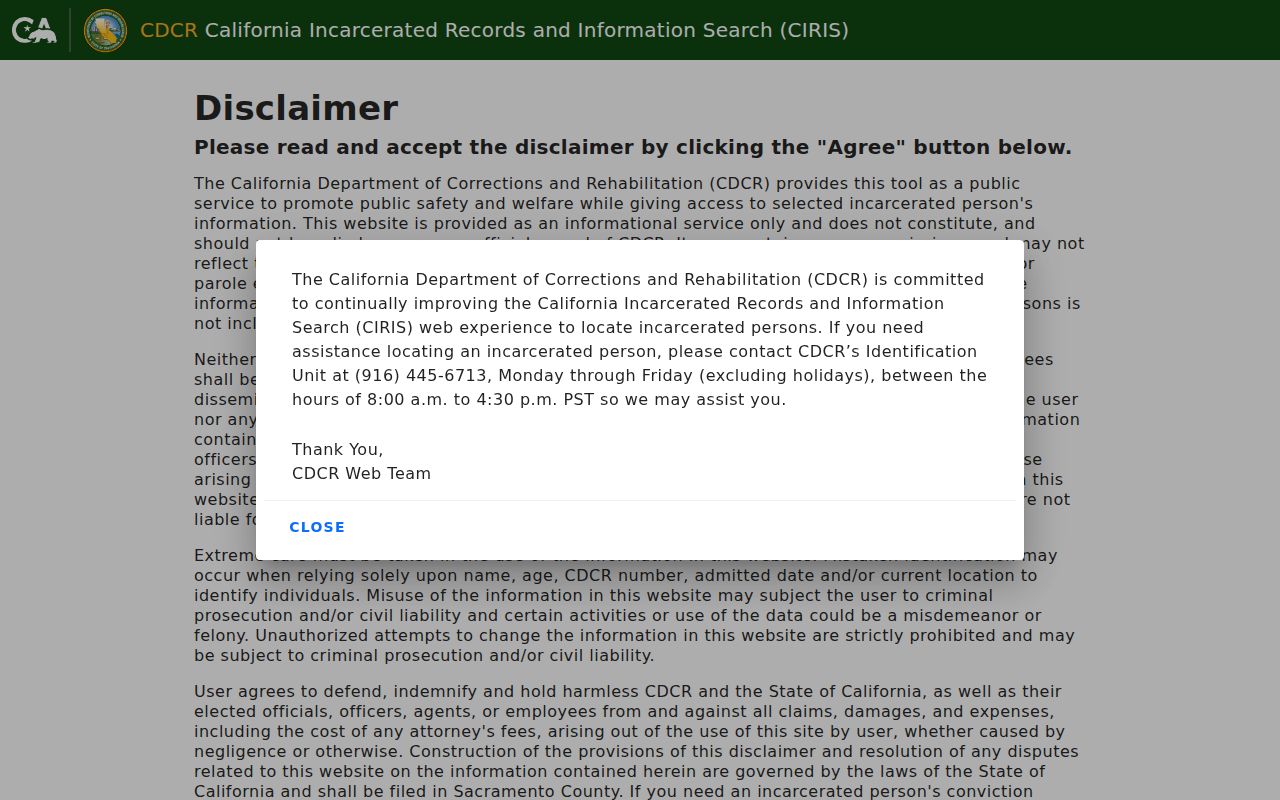
A sentence shown in the court file remains the best bridge between the county case and the correct custody system.
Orange County Criminal Case Pipeline
The Orange County District Attorney reviews law-enforcement reports and decides what charges to file. An arrest allegation is not the same as a filed count. Once a complaint, information, or indictment is filed, the Superior Court creates the case record and later records pleas, motions, outcomes, warrants, and sentence details.

The prosecutor's official page routes public case lookups back to the Orange County Superior Court.
The Orange County Public Defender is the county's official public-defense office.

Defense records are not a substitute for the clerk's public case file, but the office is part of the same Santa Ana justice hub.
Orange County Registry Records
Sex offender information comes from the California Megan's Law Website, not an Orange County registry database. Local police and OCSD register people within their jurisdictions and forward updates to DOJ. Public profiles may show a full address, a ZIP/city/county area, or no public listing, depending on California law.
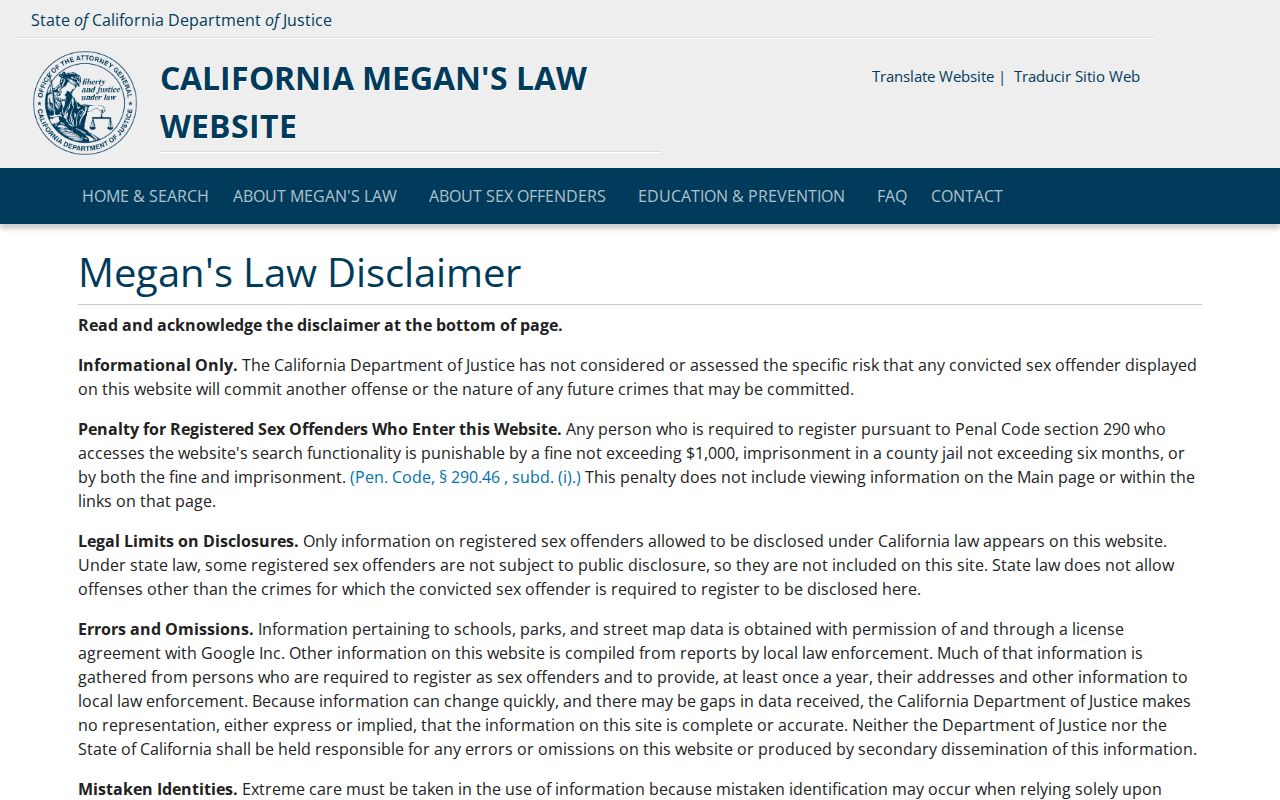
The state disclaimer also warns that data changes, mistaken identity is possible, and harassment or criminal misuse can create liability.
Criminal Records by City in Orange County
Anaheim, Irvine, and Santa Ana are Orange County's three largest incorporated cities in the research. Each police department keeps its own incident and arrest reports, while county jail bookings go to OCSD and filed criminal cases go to Superior Court. City pages focus on the local request route and the point where that record moves into county or state systems.
Anaheim Criminal History
Anaheim Police Records Bureau, city public-records channels, and county case routing.
Irvine Criminal History
Irvine Police report rules, Quick Records, fees, and county booking links.
Santa Ana Criminal History
Police records, NextRequest, and the county-seat justice center network.